PS2 BIOS Download (All Regions) – Official Files for PCSX2 & AetherSX2 Emulators 2026
Safe & Clean Files
All Regions Included
PCSX2 & AetherSX2
Easy Setup Guide
Trying to run PlayStation 2 games on PCSX2 or AetherSX2 can quickly become frustrating when your emulator displays errors like “BIOS not found,” crashes during startup, or refuses to boot games because a compatible PS2 BIOS is missing.
Many beginners are also confused by terms such as PS2 system BIOS and the different regional firmware versions, making it difficult to know which one is appropriate for their console and games.
This confusion often leads users to search for a PS2 BIOS download without understanding what the BIOS does or the importance of using firmware dumped from a PlayStation 2 console they legally own.
This guide explains everything you need to know about the PS2 BIOS, including how it works, why PCSX2 and AetherSX2 require it, and how to configure it correctly for the best emulation experience.
You’ll also learn the differences between BIOS regions, how the PS2 system affects game compatibility, common setup mistakes, and practical troubleshooting tips to resolve BIOS-related errors.
Whether you’re new to PlayStation 2 emulation or looking to optimize your existing setup, this article provides clear, beginner-friendly explanations and best practices while encouraging the use of a BIOS ROM for PS2 obtained from hardware you own.
By the end, you’ll understand the role of PS2 BIOS files, emulator compatibility, and the correct way to configure your emulator for smooth, reliable gameplay. But if you are setting up a PlayStation 1 emulation, then you will need the PS1 BIOS instead.

USA (NTSC-U)
This is the North American BIOS used for PlayStation games from the USA and Canada.



What Is PS2 BIOS?
The PS2’s BIOS (Basic Input/Output System) is the built-in firmware that comes with every PlayStation 2 console.
It is the first software that runs when you power on the console, checking the hardware, initializing system components, reading memory cards, and preparing the system to launch games.
In simple terms, the BIOS of PS2 acts as the console’s foundation, allowing all of its hardware and software to communicate properly.
This is why emulators such as PCSX2 and AetherSX2 require a compatible BIOS to recreate the original PlayStation 2 experience.
If you’re setting up a PS2 BIOS for PCSX2, using the correct BIOS version helps improve game compatibility, system stability, and overall emulation accuracy.
You may come across search terms like BIOS PS2 download or PS2 BIOS file download while looking for emulator setup guides.
These phrases usually refer to the firmware required by the emulator, but the recommended approach is to use a BIOS dumped from a PlayStation portal you legally own.
This firmware is also commonly referred to as the BIOS ROM for PS2.
Once configured correctly, the BIOS enables the emulator to boot games, create virtual memory cards, manage save data, and accurately emulate the original console’s hardware.
Think of the emulator as a car and the BIOS as its ignition key—without the key, the engine cannot start. Likewise, without a compatible BIOS, a roms PS2 emulator cannot function as intended.
PS2 BIOS File Download Details
Before setting up a PS2 BIOS download with your emulator, it’s helpful to understand the basic file information and compatibility.
PS2 BIOS files. The exact file size and available regions can vary depending on the BIOS version and the PlayStation 2 console model from which it was obtained.
| Feature | Details |
| File Name | PS2 BIOS |
| File Format | .bin |
| Approximate File Size | Varies by BIOS version (typically a few MB) |
| Supported Operating Systems | Windows, macOS, Linux, Android, iOS* |
| Compatible Emulators | PCSX2, AetherSX2, PS2emu (where supported) |
| Supported Regions | NTSC-U/C (USA), PAL (Europe), NTSC-J (Japan) |
| Purpose | Provides the PlayStation 2 firmware required for accurate emulation |
| Used For | Booting games, memory card support, system initialization, and hardware emulation |
| Latest Version | Depends on the original PlayStation 2 console firmware |
| Recommended Source | A BIOS dumped from a PlayStation 2 console you personally own |
Note: BIOS download PS2 iOS support depends on the emulator you use and your device configuration. BIOS versions, file sizes, and compatibility may vary depending on the PlayStation 2 model and region.
Why You Need a PS2 BIOS to Play PS2 Games on Emulators
A PS2 BIOS is an essential component for running PlayStation 2 games on emulators like PCSX2 and AetherSX2. While the emulator recreates the PS2’s: A PS2 BIOS file is required because it provides the original system firmware that emulators rely on to boot PlayStation 2 games and accurately reproduce the console’s hardware behavior.
Whether you’re using a PS2 emulator BIOS with PCSX2 or another compatible emulator, the BIOS initializes the CPU, memory cards, controllers, and other core components before a game starts.
You may encounter search terms such as download PS2 BIOS, ROM BIOS PS2 PCSX2, PS2-0230A BIOS, or even game-specific phrases like Gungrave PS2 BIOS, but these generally refer to the same type of PlayStation 2 firmware. For the best compatibility and an authentic emulation experience, it’s recommended to use a BIOS dumped from a PlayStation 2 console you personally own.
With the correct BIOS configured, your emulator can boot games reliably, improve stability, and support features such as virtual memory cards, save states, and controller customization.
What Does the PS2 BIOS Actually Do?
Every time you launch a PlayStation 2 emulator, the PS2 BIOS archive performs several important tasks to recreate the behavior of the original console. BIOS PS2 controller. Its main functions include:
Together, these functions allow emulators like PCSX2 and AetherSX2 to closely mimic the behavior of a real PlayStation 2 console, resulting in better compatibility, stability, and an authentic gaming experience.
Difference Between PS2 BIOS and PS2 ROMs
Many beginners think the PS2 BIOS and PS2 ROMs (ISO files) are the same, but they perform completely different functions in PlayStation 2 emulation. The Myrient PS2 BIOS bin is the console’s built-in firmware that starts the system, initializes the hardware, and allows emulators like PCSX2 and AetherSX2 to recreate the behavior of a real PlayStation 2. (Ps portal)
Without a compatible BIOS, the emulator cannot boot the virtual console or load games correctly.
A PS2 ROM or PS2 ISO, on the other hand, is the game itself. It contains the game data, including graphics, audio, levels, and gameplay files. Even if you have a game ISO, it won’t run unless the emulator has access to a compatible BIOS.
In simple terms, the BIOS starts the console, while the ROM provides the game you want to play.
| Feature | PS2 BIOS | PS2 ROM / ISO |
| Purpose | System firmware that initializes the PlayStation 2 | Game data containing the playable title |
| Primary Function | Boots the console and manages hardware | Runs the selected game |
| Typical File Size | Usually a few megabytes (varies by version) | Typically hundreds of MB to several GB |
| Required for Emulation | Yes | Yes |
| Used By | Emulator (e.g., PCSX2, AetherSX2) | Loaded by the emulator after startup |
Think of it this way: The PS2 BIOS is like the console’s operating system, while the PS2 ROM/ISO is the game disc. You need both to enjoy PlayStation 2 games in an emulator, and the recommended approach is to use a BIOS and game backups created from hardware and games you legally own.
PS2 BIOS Versions by Region: SCPH Codes and Compatibility
Before setting up a PS2 BIOS with PCSX2, AetherSX2, or another compatible emulator, it’s important to understand the different BIOS versions available for each PlayStation 2 region.
Sony released the PS2 worldwide, and every region shipped with its own firmware identified by a unique SCPH model number.
Choosing a BIOS that matches your console and game region helps improve compatibility, reduces startup issues, and delivers a more authentic emulation experience.
To save you time, we have compiled a comprehensive PS2 BIOS Pack covering all major regions, including the USA (SCPH-39001, SCPH-70012), Europe (SCPH-50003, SCPH-75004), Japan (SCPH-10000, SCPH-18000), and China.
Download the right file for your region and enjoy smooth, error-free gameplay on your emulator. But if you are setting up a PlayStation 1 emulation than you will need the PS1 BIOS instead.
Understanding the Different Types of PS2 BIOS Versions
Japan (NTSC-J) BIOS – SCPH-10000 / SCPH-18000
The NTSC-J BIOS was created for PlayStation 2 consoles sold in Japan. Early models such as SCPH-10000 and SCPH-18000 are commonly associated with Japanese-exclusive games and original hardware releases. If you enjoy titles that were released only in Japan, using the matching BIOS can provide the best compatibility and preserve the original system behavior.
- Region: Japan
- Format: NTSC-J(National Television System Committee-Japan).
- Model examples: SCPH-10000, SCPH-18000
- Required for playing Japanese PS2 games correctly.
USA (NTSC-U) BIOS – SCPH-30000 / SCPH-39001 / SCPH-70012
The PS2 USA BIOS is the most commonly used version for North American PlayStation 2 consoles. PS2 American BIOS Popular models like SCPH-39001 and SCPH-70012 are well known for their excellent compatibility with PCSX2 and remain a preferred choice for users playing NTSC-U games. If your game collection consists mainly of PS2 US BIOS releases, this BIOS is generally the recommended option.
- Region: North America
- Format: NTSC-U(National Television System Committee-United States)
- Model examples include: SCPH-39001, SCPH-70012.
- Most commonly used and widely supported in PCSX2 and AetherSX2 emulators. PS2 BIOS USA
Europe (PAL) BIOS – SCPH-50000 / SCPH-50003 / SCPH-75004
The PAL BIOS was developed for Europe, Australia, and other PAL regions. Console models such as SCPH-50003 and SCPH-75004 support PAL-format games, which typically use a 50 Hz video standard. PS2 BIOS Europe: Selecting the correct PAL BIOS helps ensure proper language support, video output, and game compatibility.
- Region: Europe, Australia, and parts of the Asian region.
- Format: PAL(Phase Alternate Line)
- Model Example: SCPH-50003, SCPH-75004.
- It is compatible with PAL-format games (50Hz refresh). PAL systems use 50Hz video output (vs. 60Hz in NTSC).
China & Other Regions (NTSC-C) – SCPH-70000 / SCPH-90006
Sony also released PlayStation 2 consoles for China and selected Asian markets. Models including SCPH-70000 and SCPH-90006 use region-specific firmware designed for those releases. Although these BIOS versions are less common, they may be useful when running games originally published for those regions.
- Region: China and related territories
- Format: NTSC-C/ PAL depending on region
- This is the less commonly used version, but it is useful for region-specific games.
Universal / Multiple BIOS Collections
Many emulator users keep BIOS dumps from several PlayStation 2 regions in the same BIOS directory. This allows emulators like PCSX2 to detect multiple BIOS versions and lets you choose the one that best matches your game’s region. While users often refer to this as the best PS2 BIOS setup, there isn’t a single universal BIOS that works best for every situation. Instead, the ideal choice depends on your PlayStation 2 model and the region of the games you intend to play.
Tip: For the highest level of compatibility and accuracy, always use a BIOS dumped from the PlayStation 2 console you personally own and select the version that matches your game’s region.
NTSC vs PAL BIOS: Which Should You Use?
Choosing between an NTSC and PAL PS2 BIOS depends on the region of your PlayStation 2 console and the games you want to play. Although emulators like PCSX2 and AetherSX2 support multiple BIOS versions, using a BIOS that matches your game’s region provides the best compatibility and helps avoid issues such as black screens, display problems, or game crashes.
NTSC-U (North America) and NTSC-J (Japan) games typically run at 60Hz, offering smoother gameplay and slightly faster performance. In contrast, PAL (Europe) games generally run at 50Hz and often include support for multiple languages. Some games were released exclusively in specific regions, so selecting the correct BIOS helps preserve the original gameplay experience and ensures proper system behavior.
NTSC vs PAL: Which BIOS Performs Better for Emulation?
| Feature | NTSC BIOS | PAL BIOS |
| Primary Regions | USA, Canada, Japan | Europe, Australia |
| Video Refresh Rate | 60Hz | 50Hz |
| Game Compatibility | NTSC-U & NTSC-J games | PAL games |
| Languages | English or Japanese | Multiple European languages |
| Best For | North American and Japanese game libraries | European and PAL-exclusive titles |
Which BIOS Should You Choose?
For the best emulation experience, always use a BIOS from a PlayStation 2 console you own and match it to the region of your game whenever possible.
Which PS2 BIOS Version Should You Use?
The best PS2 BIOS version depends on the region of your PlayStation 2 console and the games you plan to play. For the highest compatibility, it’s recommended to use a BIOS dumped from your own PS2 that matches your game’s region. This helps reduce compatibility issues, improves stability, and provides an experience that closely resembles the original hardware.
If you mainly play North American games, an NTSC-U BIOS (such as SCPH-39001 or SCPH-70012) is usually the best choice. For Japanese-exclusive titles, use an NTSC-J BIOS like SCPH-10000 or SCPH-18000. If your game library consists of European or Australian releases, choose a PAL BIOS, such as SCPH-50003 or SCPH-75004, to ensure proper video output and language support.
| Game Region | Recommended BIOS | Common SCPH Models |
| USA / Canada (NTSC-U) | NTSC-U BIOS | SCPH-39001, SCPH-70012 |
| Japan (NTSC-J) | NTSC-J BIOS | SCPH-10000, SCPH-18000 |
| Europe / Australia (PAL) | PAL BIOS | SCPH-50003, SCPH-75004 |
| China / Asia | NTSC-C BIOS | SCPH-70000, SCPH-90006 |
Quick Recommendation
Using the correct BIOS version improves game compatibility, minimizes startup errors, PS2-BIOS and ensures a smoother PlayStation 2 emulation experience on PCSX2 and AetherSX2.
How to Check If Your PS2 BIOS File Is Working?
After configuring your PS2 BIOS in PCSX2 or AetherSX2, it’s important to verify that the emulator recognizes it correctly. A working BIOS should allow the emulator to boot normally and access the PlayStation 2 system menu without displaying BIOS-related errors.
Here are a few simple ways to check if your BIOS is working:
Signs Your PS2 BIOS Is Working
If any of these checks fail, verify that you’ve selected a valid BIOS from your own PlayStation 2 console, placed it in the correct directory, and rescanned the BIOS folder within your emulator.
What Are the PlayStation 2 BIOS Features?
The PlayStation 2 BIOS is responsible for much more than simply starting the console.
It manages essential system functions that allow the PS2 and compatible emulators like PCSX2 and AetherSX2 to operate correctly.
Below are the key features of the PS2 BIOS and why they matter.
Hardware Initialization
When the PlayStation 2 is powered on, the BIOS performs a hardware check and initializes core components such as the Emotion Engine (CPU), Graphics Synthesizer (GPU), system memory, and input/output devices. This ensures the console is ready before a game begins.
Region Lockout
The BIOS verifies the console’s region, such as NTSC-U, NTSC-J, or PAL, to determine whether a game is compatible. This regional verification was designed to ensure that games matched the market for which the console was intended.
Booting Game Discs
One of the BIOS’s primary jobs is to locate the game’s startup information and begin the boot process. Once the required system checks are complete, control is transferred to the game so it can load normally.
System Configuration
The BIOS stores and manages system preferences, including language, date and time, video settings, and other console options. These settings are saved in non-volatile memory, allowing them to remain available even after the console is turned off.
Boot Menu
The PlayStation 2 BIOS provides access to the system menu, where users can manage memory cards, adjust console settings, and choose startup options. Many emulators also support both Full Boot, which displays the original startup animation, and Fast Boot, which skips it for quicker loading.
Memory Card Operations
The BIOS handles communication with PlayStation 2 memory cards, allowing games to create save files, load existing progress, and manage stored data. Emulators replicate this feature through virtual memory cards.
Firmware Updates
On certain PlayStation 2 models, the BIOS manages built-in firmware functions, including updates that improved DVD playback and enhanced overall system compatibility. These firmware-level features help maintain stable console operation.
Backward Compatibility with PS1 Games
Many PlayStation 2 consoles support original PlayStation (PS1) games. The BIOS includes compatibility features that allow supported PS1 titles to boot and run with appropriate hardware behavior, making the PS2 a versatile gaming system.
Security and Anti-Piracy Checks
The BIOS contains security mechanisms that verify discs and help prevent unauthorized software from running on the original console. These checks were designed to protect the PlayStation 2 ecosystem and ensure games met Sony’s hardware requirements.
Overall, the PS2 BIOS serves as the foundation of the PlayStation 2, coordinating hardware, system settings, storage, and game startup to deliver a stable and authentic gaming experience on both original consoles and compatible emulators.
Is Downloading or Sharing PS2 BIOS Legal?
The PlayStation 2 BIOS is proprietary firmware created by Sony and is protected by copyright. In most jurisdictions, downloading or sharing BIOS files from unauthorized websites is not permitted because the firmware is copyrighted software. While many websites offer BIOS files online, their availability does not necessarily mean they can be legally redistributed.
If you want to use a PS2 emulator such as PCSX2 or AetherSX2, the recommended approach is to use a BIOS dumped from a PlayStation 2 console you personally own. Laws regarding emulation and firmware can vary by country, so it’s always a good idea to check the copyright rules that apply in your region.
How to Legally Dump/Obtain a PS2 BIOS File
If you own an original PlayStation 2 console, there are legitimate ways to obtain a BIOS for personal emulation. The methods below are commonly used by emulator enthusiasts while respecting copyright.
Pull from Your Own PS2 Console
The most widely recommended method is to dump the BIOS from your own PlayStation 2. This creates a personal backup of the firmware installed on your console, which can then be used with compatible emulators like PCSX2 or AetherSX2. Using your own BIOS generally provides the best compatibility while respecting intellectual property rights.
Developer Pathways
Developers working on emulator software or research projects may access BIOS-related functionality through legally obtained hardware or approved development resources. Emulator projects themselves are legal in many countries because they are independently developed, but they generally do not include Sony’s BIOS firmware due to copyright restrictions.
Educational Fair Use
In some countries, BIOS firmware may be discussed, analyzed, or referenced for educational, research, interoperability, or preservation purposes. However, these exceptions are limited and do not automatically permit downloading, copying, or distributing copyrighted BIOS files. The exact scope of these exceptions depends on local copyright law.
Tip: For the safest and most compatible setup, use a BIOS created from a PlayStation 2 console you personally own and configure it according to your emulator’s documentation.
PS2 BIOS Compatibility by Region
PlayStation 2 consoles were released in multiple regions, and each uses a region-specific BIOS. When configuring an emulator such as PCSX2, AetherSX2, or RetroArch, using a BIOS dumped from your own PlayStation 2 console that matches your game’s region generally provides the best compatibility.
| BIOS Version | Region | Common Use |
| SCPH-39001 | USA (NTSC-U) | North American game compatibility |
| SCPH-70012 | USA (NTSC-U) | Later Slim console revision |
| SCPH-10000 | Japan (NTSC-J) | Original Japanese launch model |
| SCPH-18000 | Japan (NTSC-J) | Updated Japanese revision |
| SCPH-50003 | Europe (PAL) | European PlayStation 2 games |
| SCPH-75004 | Europe (PAL) | Later PAL Slim model |
| SCPH-90006 | China/Asia | Region-specific Asian releases |
All of these BIOS versions are firmware created for specific PlayStation 2 models. The recommended way to use them with an emulator is to dump the BIOS from a PlayStation 2 console you personally own and then configure it according to your emulator’s setup instructions.
Using a PS2 BIOS with Your Emulator
After obtaining a BIOS from your own console:
- Place the BIOS files in your emulator’s BIOS directory.
- Open the emulator’s BIOS settings.
- Scan or select the BIOS folder.
- Choose the BIOS that matches your game’s region.
- Save your settings and verify that the emulator detects the BIOS correctly.
Selecting the appropriate BIOS helps improve compatibility, reduces startup issues, and provides behavior that more closely matches the original PlayStation 2 hardware.
Why Use Our PS2 BIOS Setup Guide?
Whether you’re new to PlayStation 2 emulation or setting up a new device, our guide is designed to make the process simple, accurate, and beginner-friendly. Instead of relying on outdated or confusing tutorials, you’ll find clear explanations, practical tips, and step-by-step instructions to help you configure your emulator correctly using a BIOS from a PlayStation 2 console you own.
Trusted and Well-Researched Information
Our content is carefully researched and regularly reviewed to provide accurate information about PS2 BIOS files, SCPH model numbers, BIOS regions, and emulator compatibility. We focus on clear guidance rather than confusing technical jargon.
Covers All Major BIOS Regions
We explain the differences between NTSC-U (USA), NTSC-J (Japan), PAL (Europe), and other regional BIOS versions, helping you understand which one matches your PlayStation 2 console and game library.
Compatible with Popular PS2 Emulators
Our setup instructions are written for the latest versions of PCSX2 and AetherSX2, along with general guidance that applies to other compatible PlayStation 2 emulators.
Helps Prevent Common BIOS Errors
The guide walks you through common issues such as “BIOS not found,” black screens, startup failures, and configuration mistakes, making it easier to achieve stable and reliable emulation.
Easy-to-Follow Instructions
Every section is written in simple language with step-by-step explanations, making it suitable for both beginners and experienced emulator users.
Updated for New Emulator Releases
As PlayStation 2 emulators continue to improve, we update our content to reflect new features, compatibility improvements, and recommended setup practices so you always have access to current information.
Best PS2 Emulators That Support PS2 BIOS
A good emulator is just as important as the correct PS2 BIOS when it comes to smooth PlayStation 2 emulation. Different emulators are designed for different platforms and offer unique features, performance levels, and compatibility. Below are some of the most popular PS2 emulators available today.
PCSX2 (Best for Windows)
PCSX2 is the most popular and mature PlayStation 2 emulator for Windows, with support for Linux and macOS as well. It offers excellent game compatibility, upscaling, save states, widescreen patches, controller customization, and frequent updates. For standard emulation, PCSX2 is designed to work with a BIOS from a PlayStation 2 console you own, making it the preferred choice for most users.
AetherSX2 (Best for Android)
AetherSX2 is a powerful PlayStation 2 emulator built specifically for Android devices. Bios PS2 Android delivers impressive performance on supported hardware and includes features such as touchscreen controls, external controller support, graphics scaling, and save states. Like PCSX2, it is typically used with a BIOS from your own PlayStation 2 console for accurate emulation.
DamonPS2 (Alternative Choice for Android Users)
DamonPS2 is another Android-based PS2 emulator that offers support for many PlayStation 2 games and includes features like HD rendering, controller support, and memory card management. Compatibility and performance can vary depending on the device and emulator version, so users should evaluate whether it meets their needs.
RetroArch (For iOS and Advanced Users)
RetroArch is a versatile multi-system emulator frontend available on Windows, macOS, Linux, Android, and iOS. Through compatible emulator cores, it can provide PlayStation 2 emulation and offers advanced features such as shaders, netplay, achievements, and extensive controller customization. Its setup is more technical than standalone emulators, making it a better choice for experienced users.
Play! (Windows, Android, iOS) – BIOS Optional
Play! is a cross-platform PlayStation 2 emulator that runs on Windows, macOS, Linux, Android, and iOS. Unlike most PS2 emulators, Play! is designed to operate without requiring a traditional PS2 BIOS. Although it continues to improve, its game compatibility is generally not as extensive as PCSX2 for many titles.
PS2emu
PS2emu is a lightweight PlayStation 2 emulator available in various forms for different platforms. While it supports many best PS2 games, its compatibility and feature set are generally more limited than established emulators such as PCSX2. Users should verify compatibility with their specific games before choosing it.
NeutrinoSX2
NeutrinoSX2 is a newer PlayStation 2 emulation project aimed primarily at Android users. It focuses on performance improvements and a modern user experience while continuing to expand game compatibility. As development progresses, support and features may evolve over time.
Which Emulator Should You Choose?
- PCSX2 – Best overall choice for Windows, Linux, and macOS.
- AetherSX2 – Excellent option for Android devices.
- RetroArch – Great for advanced users who prefer an all-in-one emulator platform.
- Play! – Suitable if you want to explore BIOS-optional PS2 emulation.
- DamonPS2, PS2emu, and NeutrinoSX2 – Alternative options that may suit specific devices or user preferences.
Selecting the right emulator depends on your device, hardware performance, and the games you want to play. For the most accurate PlayStation 2 emulation, use an emulator that best fits your platform and configure it according to its official documentation.
How to Set Up PS2 BIOS On PC Windows (PCSX2 Emulator)
First, download PCSX2 from the official website, https://pcsx2.net/. Once downloaded, unzip the folder and open/run the file named pcsx2-qt or pcsx2, having the PCSX2 logo. Select the language and click the NEXT button.
Prepare Your BIOS file
First, get the BIOS file from the PS2 console by dumping the original console. Copy the file to the PC. The file will be in .bin format.
Import & Configure the BIOS File into PCSX2
There are two ways to import and Configure/set up the BIOS file on PCSX2. We will discuss both of them.
Method 1:
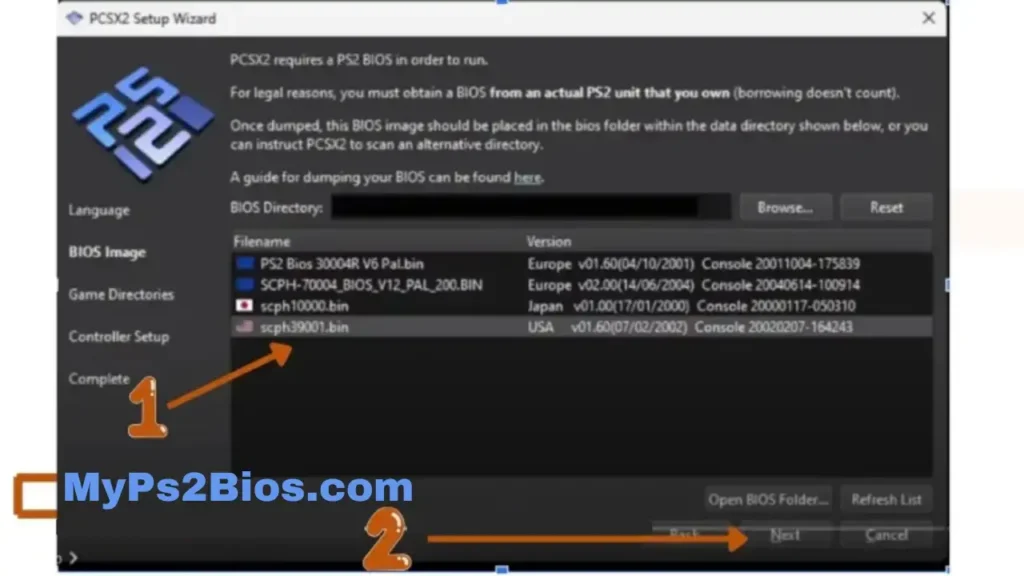
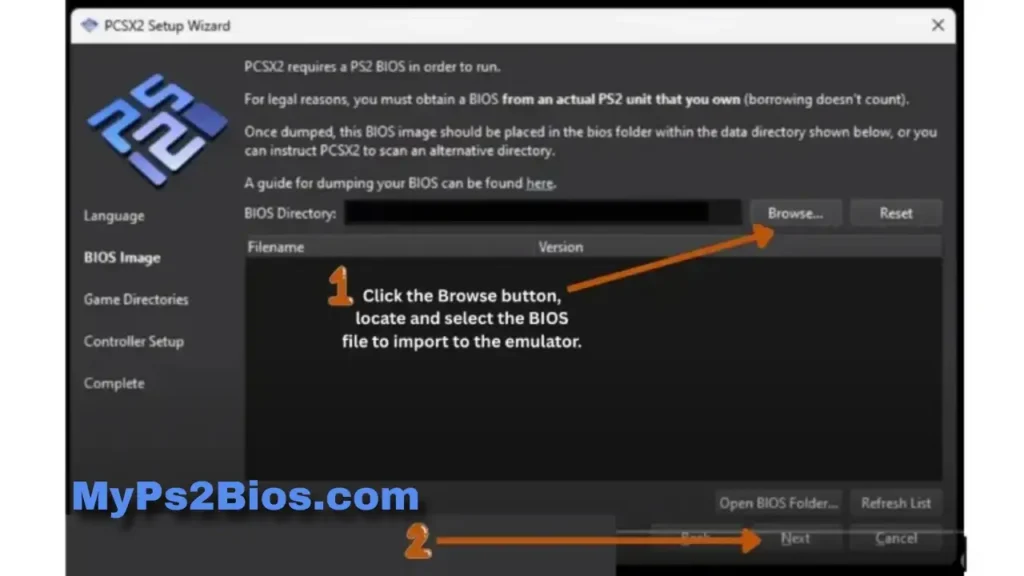
Click on the Browse button. Go to the folder that has the BIOS file (.bin file) and select it. When you select the file, it will be uploaded here. It will usually contain all four versions if you have downloaded the full pack.
Here you can see that all four versions of the BIOS file are imported here. Select your preferred version and click the NEXT button, and it will be successfully imported and configured to the PCSX2 emulator.
Method 2:
This is the second method to import and configure a BIOS file into the PCSX2 emulator. This method is processed after the successful launch of the emulator.
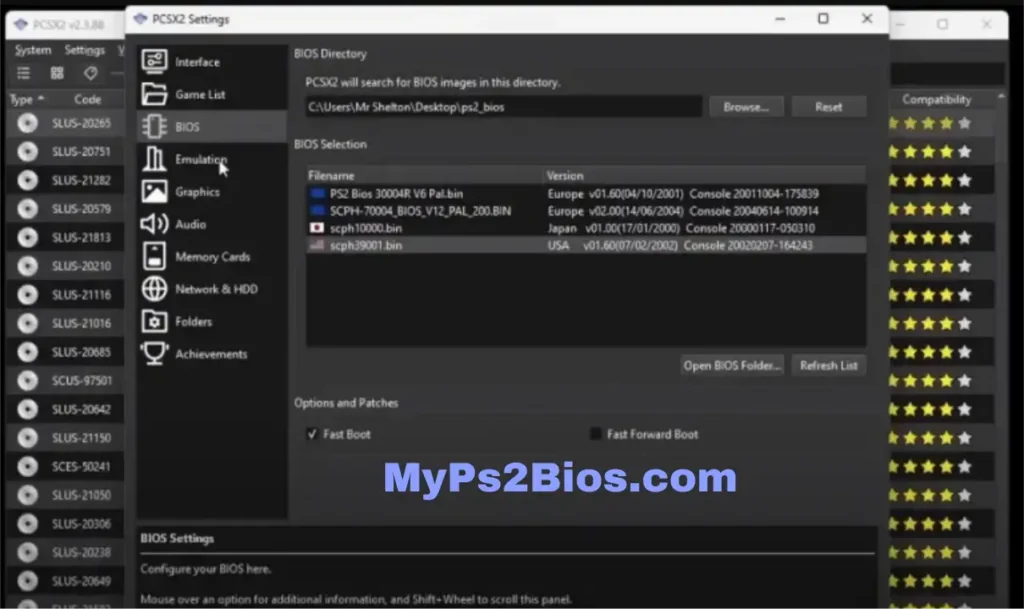
Here, click on the Browse button and import the BIOS file. This option allows you to import a BIOS file whenever you want. Besides, you can also import a single version or all versions through this method.
If you’re still having issues, you can read this detailed guide on how to download and set up the PCSX2 PS2 emulator on your PC.
Set up BIOS file on Android (AetherSX2 Emulator):
Download the AetherSX2 emulator. Search “AetherSX2 download” in Google Chrome. Download from Archive.com, Github.com, or a website. It is not available on the Play Store. Install it on mobile.
Prepare PS2 BIOS file
Get the PS2 BIOS file by dumping it from the original PS console. Copy the file to Android. The file will be in .bin format.
Import and configure the BIOS file on the AetherSX2 emulator
Open the emulator. You will get a welcome page; click on the NEXT button. There will be a settings page; set important settings according to your gaming experience, and click the NEXT button. You will get the page below.
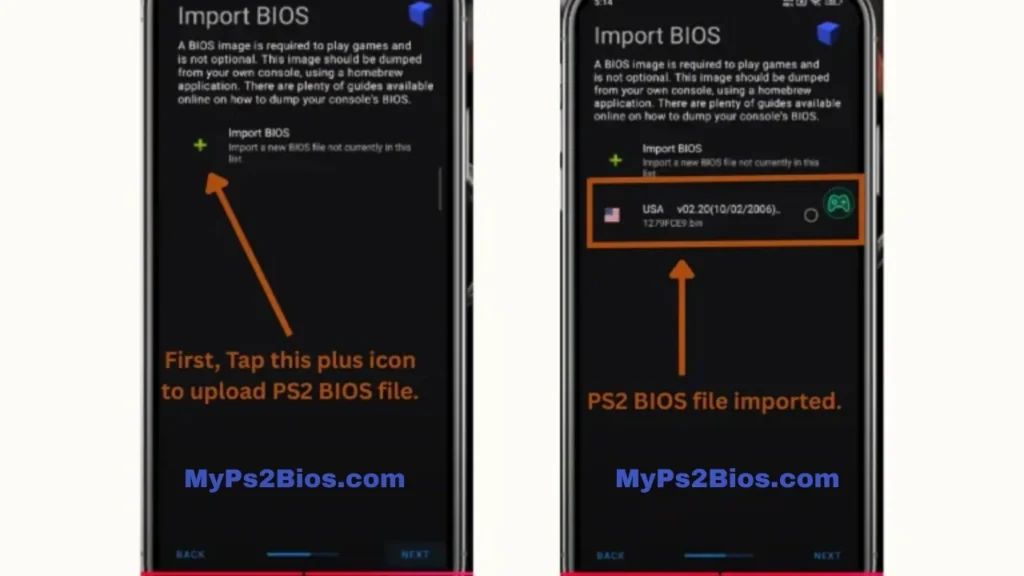
Tap on the + icon. Locate and select the BIOS file to import it here. When the file is successfully imported, it will appear on the screen as shown in the image. Here, it displays only a single version of the BIOS (USA), as we have only selected a single version.
This is how you can import the BIOS file on the AetherSX2 emulator on an Android phone.
Best Android Emulators That Support PS2 BIOS
If you want to play PlayStation 2 games on an Android device, you’ll need a compatible PS2 emulator. Most accurate PS2 emulators use a BIOS from a PlayStation 2 console you own to provide the best compatibility and performance.
PS2 BIOS File on Android
AetherSX2
AetherSX2 is widely regarded as one of the best PlayStation 2 emulators for Android. Built using technology derived from the PCSX2 project, it offers excellent game compatibility, customizable graphics settings, save states, controller support, widescreen patches, and performance enhancements for supported devices.
PS / PS2 / PSP Emulator Apps
Several Android apps are available under names such as PS / PS2 / PSP Emulator. These applications vary significantly in quality and compatibility. While some claim to support PlayStation 2 games, their performance and feature set are generally more limited than AetherSX2, so users should carefully review compatibility before using them.
DamonPS2
DamonPS2 is another Android PS2 emulator that offers features such as HD rendering, controller support, and save states. It has generated discussion within the emulation community regarding licensing and code usage, so many users prefer open-source alternatives. Compatibility and performance depend on the device and emulator version.
PS2 Pack Download (All Regions Included)
A complete PS2 BIOS pack usually includes multiple firmware versions. This allows better compatibility with PS2 ROM archive collections and different game regions.
| BIOS Version | Region |
| SCPH-39001 | USA |
| SCPH-50003 | Europe |
| SCPH-10000 | Japan |
Where to Place PS2 BIOS Files in Emulators
Placing your PS2 BIOS in the correct folder is an important step when setting up a PlayStation 2 emulator. Even if you have a valid BIOS from your own PS2 console, the emulator won’t detect it if it’s stored in the wrong directory. Keeping the BIOS in the proper location helps ensure the emulator loads correctly, recognizes different BIOS regions, and provides a stable gaming experience.
The table below shows the default BIOS locations for the most popular PS2 emulators:
| Emulator | Default BIOS Folder | Notes |
| PCSX2 (Windows) | Documents/PCSX2/bios | Place your BIOS files in the bios folder, then scan or select the directory from the emulator settings. PCSX2 can detect multiple BIOS versions if they are stored together. |
| AetherSX2 (Android) | Internal Storage/AetherSX2/bios | Copy the BIOS into the bios folder, then open AetherSX2 and select the BIOS directory during the initial setup or from the settings menu. |
Tips for Better Organization
Using the correct BIOS location helps your emulator recognize the firmware properly, reducing setup problems and ensuring a smoother PlayStation 2 emulation experience.
What Is PCSX2?
PCSX2 is a free, open-source PS2 emulator that lets you play PlayStation 2 games on modern Windows, macOS, and Linux computers. By accurately recreating the original PS2 hardware in software, the PCSX2 emulator delivers improved graphics, higher resolutions, faster loading times, and support for modern controllers while preserving the classic BIOS PlayStation 2 gaming experience.
To emulate the console accurately, the PSX2 BIOS is designed to work with a PS2 BIOS for PCSX2 that has been dumped from a PlayStation 2 console you own.
Once configured, the emulator supports advanced features such as save states, virtual memory cards, HD upscaling, widescreen patches, texture filtering, and customizable graphics settings.
It also includes built-in support for PCSX2 cheats, automatic game cover management through features such as Auto Get Covers and PCSX2 Cover Downloader, and compatibility with a wide range of USB and Bluetooth controllers, including devices like the PDP Riffaster when properly configured.
Whether you’re replaying classics or experimenting with community resources such as Fallout: Brotherhood of Steel cheats for PCSX2, PCSX2 remains one of the most accurate and actively maintained PlayStation 2 emulators available today.
To install the emulator safely, always use the official PCSX2 download from the project’s website and configure it using a PS2 BIOS emulator from your own PlayStation 2 PS2 BIOS.
Key Features of PCSX2
PCSX2 has become the leading PlayStation 2 emulator thanks to its excellent compatibility, frequent updates, and powerful customization options. Whether you’re playing on a desktop computer or exploring community projects related to PCSX2 Android, the emulator offers a feature-rich experience that closely replicates the original PS2 hardware.
Some of its standout features include:
Note: For accurate PlayStation 2 emulation, the PCSX2 BIOS is designed to be configured with a BIOS dumped from a PlayStation 2 console you own. This provides the best compatibility and faithfully reproduces the behavior of the original hardware.
How to Download PCSX2 Emulator
Downloading PCSX2 is quick and straightforward. To ensure you receive the latest features, performance improvements, and security updates, always download the emulator from its official website. Avoid unofficial sources, as they may provide outdated or modified versions.
Follow these simple steps to download PCSX2:
- Visit the official PCSX2 website.
- Click the Download button on the homepage.
- Select the version that matches your operating system (Windows, macOS, or Linux).
- Download the latest stable or nightly build, depending on your preference.
- Once the installer has finished downloading, you’re ready to install and configure PCSX2 on your computer.
Tip: Before installing PCSX2, verify that your computer meets the recommended system requirements for smooth PlayStation 2 emulation. After installation, configure the emulator using a BIOS dumped from a PlayStation 2 console you own for the most accurate emulation experience.
How to Set Up PCSX2 on Windows & macOS (Step-by-Step)
Setting up PCSX2 is a straightforward process once you have everything you need. After installing the emulator, you’ll configure your graphics, controller, and game library before selecting a BIOS dumped from a PlayStation 2 console you own.
Taking a few minutes to complete the setup correctly will help ensure better compatibility, smoother performance, and a more authentic PlayStation 2 gaming experience.
What You Need Before You Start
Before installing and configuring PCSX2, make sure you have the following:
| Requirement | Details |
| Operating System | Windows 10/11 or macOS (Apple Silicon is supported in PCSX2 2.0 and later). |
| Memory (RAM) | Minimum 4 GB RAM; 8 GB or more is recommended for HD rendering and smoother gameplay. |
| PlayStation 2 BIOS | A BIOS dumped from a PlayStation 2 console you own. PCSX2 requires this for accurate emulation. |
| Game Backup | A legally created backup of a PlayStation 2 game in ISO, CSO, or CHD format. |
| Controller | A keyboard or a compatible USB/Bluetooth controller, including Xbox and PlayStation controllers. |
Once you have these requirements ready, you can install PCSX2, configure the emulator, select your BIOS, and begin playing your favorite PlayStation 2 games.
What Is AetherSX2?
AetherSX2 is a powerful and free PlayStation 2 (PS2) emulator designed for Android devices. Built using technology derived from the PCSX2 project, the AetherSX2 emulator allows users to enjoy many classic PS2 games on supported smartphones and tablets with improved graphics, customizable controls, save states, and widescreen enhancements.
Thanks to its excellent compatibility and performance, AetherSX2 BIOS has become one of the most popular PS2 emulators for Android.
To accurately emulate the original PlayStation 2 hardware, AetherSX2bios is designed to work with a BIOS dumped from a PlayStation 2 console you own. The emulator supports features such as hardware rendering, virtual memory cards, external game controllers, and graphics customization for smoother gameplay.
Although some users search for terms like AetherSX2 APK, AetherSX2 download, or AetherSX2 PC, the official project is intended for Android devices. To ensure security and receive the latest updates, download the emulator only from its official distribution channels or reputable app stores and avoid unofficial APK sources.
How to Set Up AetherSX2 on Android (Step-by-Step Guide)
AetherSX2 is one of the most popular PlayStation 2 emulators for Android, offering excellent performance and compatibility on many modern smartphones and tablets. If your device meets the recommended requirements and you’ve already installed the emulator, the setup process only takes a few minutes.
How to Set Up PS2 BIOS on AetherSX2 Emulator for Android?
What You’ll Need
Before getting started, make sure you have the following: CoolROM PS2 BIOS NethersX2
| Requirement | Details |
| Android Version | Android 8.0 (Oreo) or later |
| Memory (RAM) | 2 GB minimum (4 GB or more recommended) |
| File Manager | Any file manager capable of browsing internal storage (such as ZArchiver or your device’s built-in file manager) |
| PlayStation 2 BIOS | A BIOS dumped from a PlayStation 2 console you own |
| Game Backup | A legally created PS2 game backup in ISO, CSO, or CHD format |
Step-by-Step Setup
- Install AetherSX2 from an official distribution source.
- Open your file manager and create a folder named PS2 BIOS if you don’t already have one.
- Copy your PlayStation 2 BIOS files into that folder.
- Launch AetherSX2 and complete the initial setup wizard.
- When prompted, tap BIOS Directory and select the folder containing your BIOS files.
- Wait while the emulator scans and detects the available BIOS.
- Choose your preferred boot option, such as Fast Boot or Full Boot.
- Add the folder containing your PS2 game backups.
- Select a game from your library to begin playing.
Common Setup Mistake
A frequent issue is selecting the individual BIOS file instead of the folder that contains it. If AetherSX2 cannot detect your BIOS, verify that you selected the correct directory and that the BIOS files are stored inside that folder. If necessary, refresh the BIOS directory or restart the emulator after updating the settings.
How to Set Up RetroArch on iPhone & Android
RetroArch is a powerful multi-system emulator frontend that lets you organize and launch games from a single application. It supports multiple gaming systems through emulator cores and is available for iPhone, iPad, Android, Windows, macOS, and Linux.
If your selected PlayStation 2 core requires a BIOS, you’ll need to configure a BIOS dumped from a PlayStation 2 console you own.
Setting Up RetroArch on iPhone
- Install RetroArch from the Apple App Store.
- Launch the app and complete the initial setup.
- Open the Main Menu and download a compatible PlayStation 2 core if one is available for your platform and RetroArch version.
- Copy your PlayStation 2 BIOS to your device using the Files app, AirDrop, or another file transfer method.
- In RetroArch, go to Settings → Directory → System/BIOS and select the folder containing your BIOS files.
- Import your legally created PlayStation 2 game backups by choosing Main Menu → Import Content or Load Content.
- Select your preferred PS2 core and launch the game.
Setting Up RetroArch on Android
The process is similar on Android:
- Install RetroArch from an official source.
- Download a compatible PlayStation 2 core if supported.
- Configure the System/BIOS directory to point to your BIOS folder.
- Import your PS2 game backups.
- Launch your game using the selected emulator core.
Tip: Before configuring RetroArch, verify that your chosen PlayStation 2 core supports your device and operating system, as core availability and compatibility can differ between platforms and RetroArch releases.
Common PS2 BIOS Errors & How to Fix Them
Even after setting up your PS2 emulator correctly, you may occasionally encounter BIOS-related issues. Most of these problems are easy to resolve by checking your emulator settings, BIOS configuration, or game compatibility. Below are the most common PS2 BIOS errors and their solutions.
BIOS Not Found Error
The “BIOS Not Found” error usually appears when your emulator cannot detect a valid BIOS file. This often happens if the BIOS is placed in the wrong folder, the file is corrupted, or the BIOS directory hasn’t been selected correctly.
How to Fix It:
- Make sure the BIOS is placed in the correct BIOS folder.
- Rescan or reselect the BIOS directory in your emulator.
- Verify that the BIOS file is complete and not corrupted.
- Restart the emulator after changing the BIOS settings.
Black Screen After Loading a Game
If your game gets stuck on a black screen, the problem is often related to incorrect emulator settings, incompatible graphics options, or a BIOS/game region mismatch.
How to Fix It:
- Confirm that your BIOS region matches the game’s region.
- Update your emulator to the latest version.
- Reset graphics settings to their default values.
- Test the game with another compatible BIOS from your own console if available.
Lag or Stuttering Issues
Slow gameplay or frequent stuttering is usually caused by hardware limitations or demanding graphics settings rather than the BIOS itself.
How to Fix It:
- Lower the internal rendering resolution.
- Close unnecessary background applications.
- Enable recommended speed or performance settings.
- Update your graphics drivers (PC) or use Performance Mode (Android).
Region Mismatch Problems
Using a BIOS from a different region than your game may result in boot failures, language issues, or compatibility problems.
How to Fix It:
- Match NTSC-U games with an NTSC-U BIOS.
- Use a PAL BIOS for European games.
- Select an NTSC-J BIOS for Japanese titles.
- If you have multiple BIOS dumps from consoles you own, choose the one that matches the game’s region.
Controller Not Working
Sometimes controllers aren’t detected because of incorrect input settings instead of BIOS issues.
How to Fix It:
- Reconfigure your controller in the emulator settings.
- Reconnect or restart your controller.
- Update controller drivers if you’re playing on Windows.
- Verify that the correct input device is selected.
Tips for Better Performance and Compatibility
A properly configured emulator provides smoother gameplay and better compatibility with PlayStation 2 games. These tips can help you get the best experience.
- Always use the latest version of PCSX2 or AetherSX2.
- Use a BIOS dumped from your own PlayStation 2 console.
- Match the BIOS region with the region of your games.
- Keep your graphics drivers up to date.
- Lower the internal resolution if your device struggles with performance.
- Enable hardware acceleration when supported by your emulator.
- Use virtual memory cards to safely store game progress.
- Save your emulator settings before making major configuration changes.
- Close unnecessary background programs while gaming.
- Check each game’s compatibility notes if you encounter unexpected issues.
Following these best practices can significantly improve stability, reduce crashes, and provide a smoother PlayStation 2 emulation experience across Windows, Android, macOS, and other supported platforms.
Conclusion
The PS2 BIOS is the foundation of accurate PlayStation 2 emulation, allowing emulators like PCSX2 and AetherSX2 to recreate the behavior of the original console. Whether you’re configuring PCSX2 on Windows, macOS, or Linux, or setting up AetherSX2 on Android, using the correct BIOS dumped from a PlayStation 2 console you legally own is the best way to achieve reliable compatibility and stable performance.
Understanding regional BIOS versions and how the PlayStation 2 firmware works helps you choose the right setup for your games.
Throughout this guide, we’ve explained what the PS2 BIOS is, how to configure it in PCSX2 and AetherSX2, troubleshoot common issues, and optimize your emulator for smoother gameplay.
If you’re deciding which BIOS to use, the best choice is one that matches the region of both your PlayStation 2 console and your game library.
By keeping your emulator up to date, using the correct BIOS configuration, and following the compatibility and setup tips covered in this guide, you’ll be able to enjoy classic PlayStation 2 games with an authentic, stable, and reliable emulation experience.