Download PS1 BIOS (All Regions) for ePSXe, DuckStation & RetroArch 2026
Safe & Clean Files
All Regions Included
PCSX2 & AetherSX2
Easy Setup Guide
Trying to play PlayStation 1 games on DuckStation, ePSXe, or RetroArch but running into black screens, crashes, or missing audio? In many cases, the problem is related to an incorrect PS1 BIOS configuration rather than the game itself.
Many users search for terms like PS1 BIOS download, PS1 US BIOS, BIOS PSX, or BIOS for PS1, but often end up confused by different BIOS regions, firmware versions, and emulator requirements.
This guide explains what a PS1 BIOS file is, how it improves compatibility, game loading, memory card support, and overall emulation accuracy, and why choosing the correct BIOS matters.
You’ll also learn how to configure a legally obtained PS1 BIOS for DuckStation, ePSXe, and RetroArch, understand the differences between regional BIOS versions, and troubleshoot common setup issues.
Whether you’re a beginner or an experienced retro gamer, this guide provides clear, accurate, and easy-to-follow information to help you get the best PlayStation emulation experience.

USA (NTSC-U)
The North American version compatible with PS2 games from the USA and Canada.



What Is the PS1 BIOS? Why Do You Need it?
The PS1 BIOS (Basic Input/Output System) is the original firmware stored on every PlayStation 1 console. It initializes the console’s hardware, verifies game discs, manages memory cards, and prepares the system before a game starts.
In emulation, a genuine BIOS PlayStation 1 firmware allows supported emulators to reproduce the behavior of the original console more accurately than software-only alternatives.
One of the best-known PS1 BIOS files is SCPH1001.BIN, which is widely recognized for its compatibility with many North American PlayStation games.
If you’ve searched for terms like BIOS PS1 download, PSX BIOS download, or BIOS file PS1, it’s important to understand that the BIOS itself is copyrighted firmware. The recommended approach is to use a BIOS dumped from a PlayStation console you own. Once you have a legally obtained BIOS, it can be used with popular emulators such as DuckStation, ePSXe, and RetroArch for improved compatibility and accuracy.
Whether you’re setting up a PS1 emulator BIOS for the first time or configuring a Moma PS1 BIOS DuckStation installation, using the correct firmware helps reduce crashes, graphical glitches, audio problems, and game compatibility issues.
A properly configured BIOS emulator PS1 setup also provides the authentic PlayStation startup sequence and more reliable gameplay across a wide range of classic titles.
Why Is the PS1 BIOS Important?
A properly configured BIOS helps provide: PS One BIOS
PS1 BIOS File Information (Size, Format & Requirements)
| Specification | Details |
| File Name | PS1 BIOS (e.g., SCPH1001.BIN, SCPH5500.BIN, SCPH5501.BIN, SCPH5502.BIN, SCPH7003.BIN) |
| File Size | Approximately 512 KB to 2 MB (depends on the BIOS version and region) |
| File Format | .bin (most common), .rom (supported by some emulators) |
| Compatible Operating Systems | Windows, macOS, Linux, Android, and iOS |
| Compatible Emulators | DuckStation, ePSXe, RetroArch, Mednafen, XEBRA |
| Primary Purpose | Required for accurate PlayStation 1 emulation, game booting, memory card support, and improved compatibility |
| Region Support | USA (NTSC-U), Europe (PAL), Japan (NTSC-J), and Multi-Region BIOS versions |
| Recommended BIOS | SCPH1001.BIN (USA), SCPH5501.BIN (USA), SCPH5502.BIN (Europe), SCPH5500.BIN (Japan) |
| Latest Official Firmware | No new official BIOS releases; original PlayStation BIOS revisions remain the standard firmware used by emulators |
Why Is a PS1 BIOS Needed for Emulation?
A PS1 BIOS is a core part of the original PlayStation system, and it plays the same role when using an emulator. Without a properly configured BIOS, many PlayStation emulators may fail to start games correctly or may experience compatibility issues, missing features, or inaccurate hardware behavior.
Using a genuine BIOS helps the emulator closely reproduce the way the original console works, resulting in a more stable and authentic gaming experience.
Better Stability
Using the correct BIOS reduces the chances of crashes, graphical glitches, audio issues, and unexpected errors. It provides a more stable foundation for emulators like DuckStation, ePSXe, and RetroArch, allowing games to run more smoothly and accurately.
Authentic Gameplay
The BIOS initializes the PlayStation hardware before a game starts, allowing the emulator to recreate the original boot process, system behavior, and gameplay experience as faithfully as possible.
Game Verification
Many PlayStation titles rely on the BIOS during startup to initialize system components and verify that the game can be launched correctly. This helps improve compatibility with a wide range of games.
Loading & Saving
A PS1 BIOS manages memory card functions, making it easier to load saved progress, create new save files, and maintain reliable game data during gameplay.
PS1 BIOS Versions by Region
The Sony PlayStation 1 BIOS was released in several regional versions to match different PlayStation consoles worldwide. Each BIOS is designed for a specific television standard and game region, helping emulators accurately reproduce the behavior of the original hardware.
Choosing the correct BIOS improves game compatibility, reduces startup issues, and delivers a more authentic PlayStation experience. While most modern emulators support multiple BIOS versions, using the one that matches your game’s region is generally recommended.
USA / NTSC-U BIOS (SCPH1001.BIN)
The SCPH1001.BIN file, often referred to as PS1 SCPH1001 or SCPH1001 PS1, is one of the most widely used BIOS versions for North American PlayStation games. It supports the NTSC-U video standard and is known for its excellent compatibility with classic U.S. game releases. Many retro gaming enthusiasts consider the PS1 BIOS USA version one of the most reliable choices when playing North American titles on emulators like DuckStation, ePSXe, and RetroArch.
Best for:
- Designed for North American Consoles.
- Runs NTSC (60Hz) format games.
- Most popular BIOS because it is highly compatible, stable, and widely supported by emulators.
- Example: scph1001.bin, scph5501.bin.
Europe / PAL BIOS (SCPH7502.BIN)
The SCPH7502.BIN BIOS was developed for European PlayStation consoles that use the PAL video standard. It is recommended for games released in Europe, Australia, and other PAL regions. Using the correct PAL BIOS helps ensure proper video timing, smoother gameplay, and fewer compatibility issues with region-specific titles.
Best for:
- Designed for European consoles.
- Runs PAL (50Hz) format games, which sometimes run slightly slower than NTSC versions.
- Good for European-exclusive releases.
- Example: scph5502.bin, scph7502.bin
Japan / NTSC-J BIOS (SCPH5500.BIN)
The SCPH5500.BIN BIOS is the official firmware for Japanese PlayStation consoles. It is designed for NTSC-J games and provides the highest level of compatibility with titles released exclusively in Japan. If you enjoy importing or preserving classic Japanese PlayStation games, this BIOS is typically the preferred choice.
Best for:
- Designed for Japanese consoles.
- Runs NTSC (60Hz) format games, but with Japanese language and region restrictions.
- Useful for playing Japan-exclusive titles.
- Example: scph5500.bin, scph7000.bin
We also added some other bios files that were dumb by various gamers:
- SCPH-1000 [NTSC-J]
- SCPH-1002 [PAL]
- SCPH-3000 [NTSC-J]
- SCPH-3500 [NTSC-J]
- SCPH-5000 [NTSC-U/C]
- SCPH-5501 [NTSC-U/C]
- SCPH-7002 [PAL]
- SCPH-7501 [NTSC]
- SCPH-9002 [PAL]
- SCPH-100 [NTSC-J]
- SCPH-101 [NTSC-U/C]
- SCPH-5502 [PAL]
- SCPH-5552 [PAL]
- SCPH-7000 [NTSC-J]
- SCPH-7001 [NTSC-U/C]
- SCPH-102A [PAL]
- SCPH-102B [PAL]
Worldwide / Multi-Region BIOS (SCPH7003.BIN)
The SCPH7003.BIN BIOS is commonly associated with PlayStation consoles released in multiple international markets. Although it isn’t a universal BIOS that automatically supports every game region, many emulators recognize it and provide excellent compatibility for a wide variety of PlayStation titles when paired with the appropriate emulator settings.
Best for:
- International PlayStation consoles
- Broad emulator compatibility
- General-purpose PlayStation emulation
Other Variants (Brazil, China & Other Regions)
Sony also released additional BIOS revisions for certain regional PlayStation models, including systems sold in Brazil, China, and other markets. These versions mainly differ in language support, hardware revisions, and regional firmware settings. Unless you’re emulating a console from one of these specific regions, most users won’t need these BIOS revisions.
- A South American BIOS version (Brazil). Functionally similar to the US NTSC BIOS, but less commonly used.
- Useful for authenticity, but most emulators work best with scph1001.bin
- Example: scph7003.bin
Which PS1 BIOS Is the Best?
There isn’t a single best PlayStation BIOS for every situation. The ideal choice depends on the region of the games you want to play and the emulator you’re using. For most users, SCPH1001.BIN remains one of the most popular options because of its excellent compatibility with North American games and widespread support across modern emulators. However, if you’re playing European or Japanese titles, it’s generally best to use the matching regional BIOS for the most accurate experience.
If you’ve searched online for terms like download BIOS PS 1 or lucky luke PS1 game BIOS, it’s important to remember that the PlayStation BIOS is copyrighted firmware. The recommended approach is to use a BIOS dumped from a PlayStation console you own, ensuring both legal use and accurate emulation. By selecting the correct regional BIOS, you can enjoy smoother gameplay, better compatibility, and an experience that closely matches the original Sony PlayStation 1 BIOS.
Difference Between PS1 and PS2 BIOS
Although both the PS1 BIOS and PS2 BIOS serve the same basic purpose—starting the console and preparing it to run games—they are designed for entirely different PlayStation systems. Each BIOS contains firmware specifically developed for its respective hardware, meaning they are not interchangeable. If you try to use a PS1 BIOS with a PlayStation 2 emulator or a PS2 BIOS with a PlayStation 1 emulator, the emulator will fail to function correctly.
The PS1 BIOS is intended for PlayStation 1 emulators such as DuckStation, ePSXe, and RetroArch, while the PS2 BIOS is required by emulators like PCSX2 and AetherSX2. Choosing the correct BIOS ensures better compatibility, accurate hardware emulation, and a smoother gaming experience.
| Feature | PS1 BIOS | PS2 BIOS |
| Designed For | Original PlayStation (PS1) | PlayStation 2 (PS2) |
| Compatible Games | PS1 Games | PS2 Games |
| Supported Emulators | DuckStation, ePSXe, RetroArch, Mednafen | PCSX2, AetherSX2, Play! |
| Firmware Purpose | Boots the PS1, manages memory cards, verifies game discs | Boots the PS2, initializes hardware, supports DVDs, memory cards, and advanced system features |
| Hardware Compatibility | PlayStation 1 only | PlayStation 2 only |
| File Compatibility | Cannot be used with PS2 emulators | Cannot be used with PS1 emulators |
Key Takeaway: Always use the BIOS that matches the console you’re emulating. A PS1 BIOS is required for PlayStation 1 games, while a PS2 BIOS is required for PlayStation 2 games.
PS1 BIOS vs. HLE (High-Level Emulation)
When setting up a PlayStation emulator, you’ll usually have two options: use an authentic PS1 BIOS or rely on High-Level Emulation (HLE). Both methods allow games to run, but they differ significantly in terms of accuracy, compatibility, and overall gaming experience.
A genuine PS1 BIOS uses the original PlayStation firmware to emulate the console exactly as it was designed. HLE, on the other hand, recreates the BIOS functions through software without requiring the original firmware. While HLE is convenient for quick setup, it may not fully replicate the behavior of the original hardware, which can lead to compatibility issues with some games.
| Feature | PS1 BIOS | HLE (High-Level Emulation) |
| Uses Original Firmware | Yes | No |
| Authentic PlayStation Startup | Yes | Usually No |
| Game Compatibility | Excellent | Good, but some games may have issues |
| Graphics & Audio Accuracy | Very High | Moderate |
| Memory Card Support | Full Support | Basic Support |
| System Accuracy | Closely matches original hardware | Simulates BIOS behavior through software |
| Ease of Setup | Requires a legally obtained BIOS | Works without a BIOS in supported emulators |
Which One Should You Choose?
If you want the most authentic PlayStation experience with better compatibility, accurate graphics, reliable save functionality, and fewer glitches, using an original PS1 BIOS is the better option.
If you’re simply testing an emulator or playing a game that supports it, HLE can be a convenient alternative because it doesn’t require BIOS firmware. However, for long-term use and the best overall emulation quality, most experienced users prefer an authentic BIOS whenever possible.
Key Features of PS1 BIOS in Emulators
The PS1 BIOS is much more than a simple startup file. It serves as the firmware that allows PlayStation emulators to replicate the behavior of the original Sony PlayStation console with greater precision.
Whether you’re using DuckStation, ePSXe, RetroArch, or another compatible emulator, a properly configured BIOS improves game compatibility, system stability, memory card functionality, and overall emulation accuracy. Below are the key features that make the PlayStation 1 BIOS an essential part of a reliable retro gaming experience.
Authentic Start-Up Sequence
The PS1 BIOS recreates the original Sony PlayStation boot animation and hardware initialization, delivering the same startup experience as the physical console. This improves emulator authenticity and ensures games begin exactly as they did on the original system.
High Game Compatibility
A genuine PlayStation 1 BIOS allows emulators like DuckStation, ePSXe, and RetroArch to run a larger library of PS1 games with fewer crashes or compatibility issues. It also improves support for games that rely on original firmware functions.
Memory Card Management
The BIOS manages virtual PlayStation memory cards, allowing games to save, load, and organize progress just like on an original PS1 console. This ensures reliable save data and minimizes the risk of corrupted game files.
Region Support / Unlocking
Different BIOS versions support NTSC-U, PAL, and NTSC-J game regions, helping emulators run region-specific titles with proper video standards and timing. Many emulators also offer optional region switching for broader compatibility.
Disc Management
The PS1 BIOS initializes and verifies game discs or disc images before launching them, ensuring they are recognized correctly by the emulator. It also supports smooth disc swapping in compatible multi-disc PlayStation games.
Improved Performance
Although the BIOS doesn’t directly increase FPS, it improves hardware accuracy, reducing crashes, glitches, and loading problems during gameplay. This results in a smoother and more stable emulation experience.
Audio & Video Synchronization
The original BIOS keeps game audio, music, cutscenes, and graphics synchronized, closely matching the timing of the real Sony PlayStation hardware. This minimizes audio lag and improves overall gameplay quality.
Firmware Accuracy
Using the official PlayStation 1 BIOS enables emulators to accurately reproduce the console’s original firmware behavior and system functions. This provides better compatibility, fewer emulation errors, and a more authentic retro gaming experience.
Backward Compatibility with PS1 Games
Many PlayStation 2 consoles support original PlayStation (PS1) games. The BIOS includes compatibility features that allow supported PS1 titles to boot and run with appropriate hardware behavior, making the PS2 a versatile gaming system.
How to Set Up PS1 BIOS on PC (ePSXe, DuckStation, RetroArch & More)
Setting up the PS1 BIOS correctly is one of the most important steps for accurate PlayStation emulation. Once the BIOS is configured, emulators can boot games properly, improve compatibility, and deliver an experience much closer to the original PlayStation console. PSX BIOS download. Follow the steps below to install and configure the BIOS on your Windows, macOS, or Linux computer.
Download the Required Files
Before you begin, make sure you have the following:
- A legally obtained PS1 BIOS file (such as SCPH1001.BIN)
- A PlayStation emulator (DuckStation, ePSXe, or RetroArch)
- An extraction tool like 7-Zip or WinRAR (if your files are compressed)
Extract the Files / Unzip the Files
Install your preferred extraction software if it isn’t already available on your computer. Extract both the BIOS archive and the emulator files so they are in their original formats, such as .bin for the BIOS.
For better organization, create a dedicated folder for your BIOS and emulator files before proceeding with the installation.
Configure the BIOS in Your Emulator
Each emulator has a slightly different BIOS setup process. Follow the instructions below for your preferred emulator.
For ePSXe
- Install and launch ePSXe.
- Click Config from the top menu.
- Select BIOS.
- Browse to the folder containing your BIOS file.
- Select the BIOS and confirm your selection.
- Save the settings and restart the emulator if required.
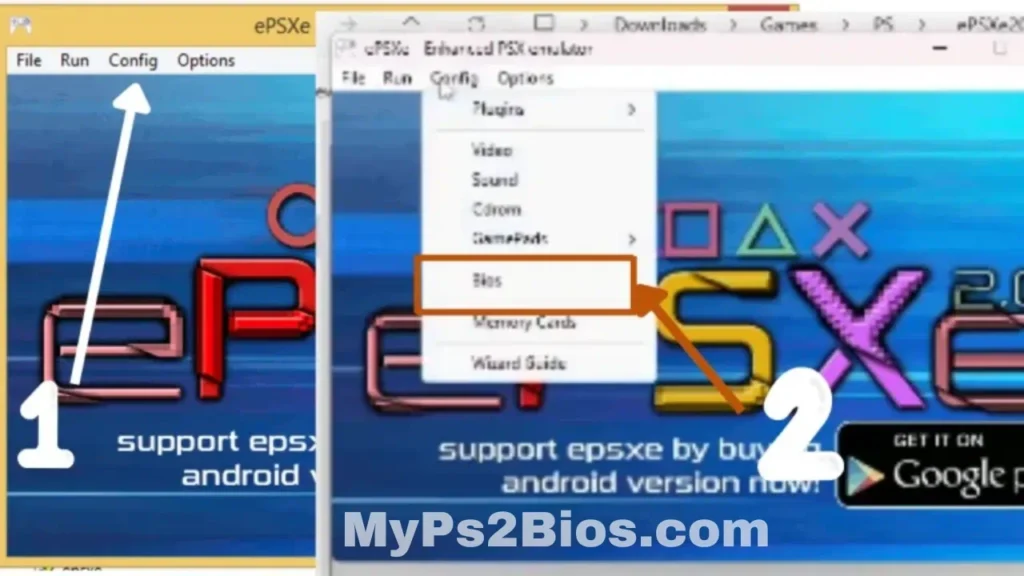
Follow the process below to import the Bios.
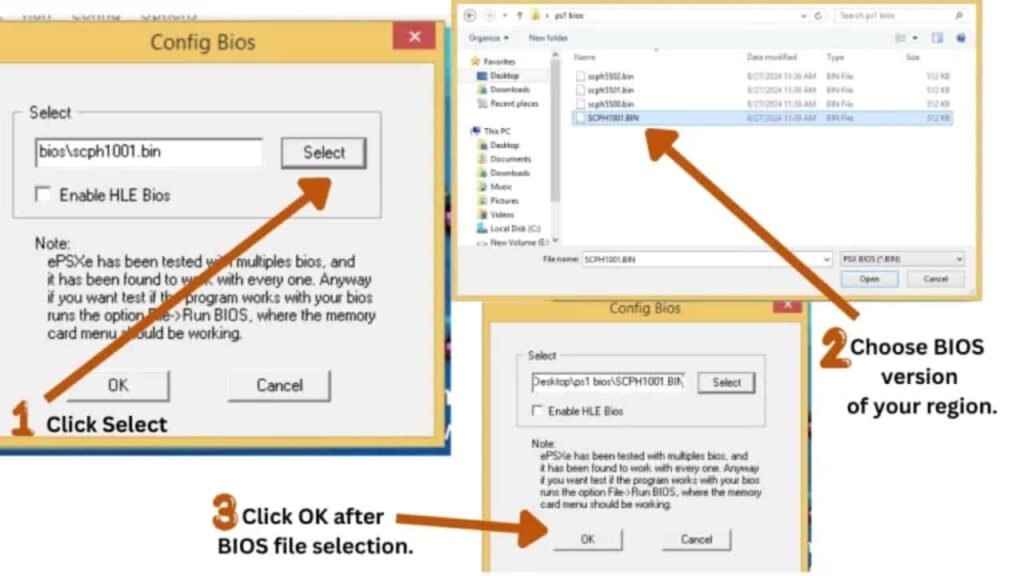
For RetroArch
- Copy your BIOS file (for example, SCPH1001.BIN, SCPH5500.BIN, or SCPH5502.BIN) into the RetroArch System folder.
Default locations:
Windows
C:\Users\YourName\AppData\Roaming\RetroArch\system
macOS
~/Library/Application Support/RetroArch/system
Linux
~/.config/retroarch/system
RetroArch usually detects the BIOS automatically after it is placed in the correct folder.
If it doesn’t:
- Open RetroArch.
- Go to Settings → Directory.
- Select System/BIOS.
- Choose the folder where your BIOS is stored.
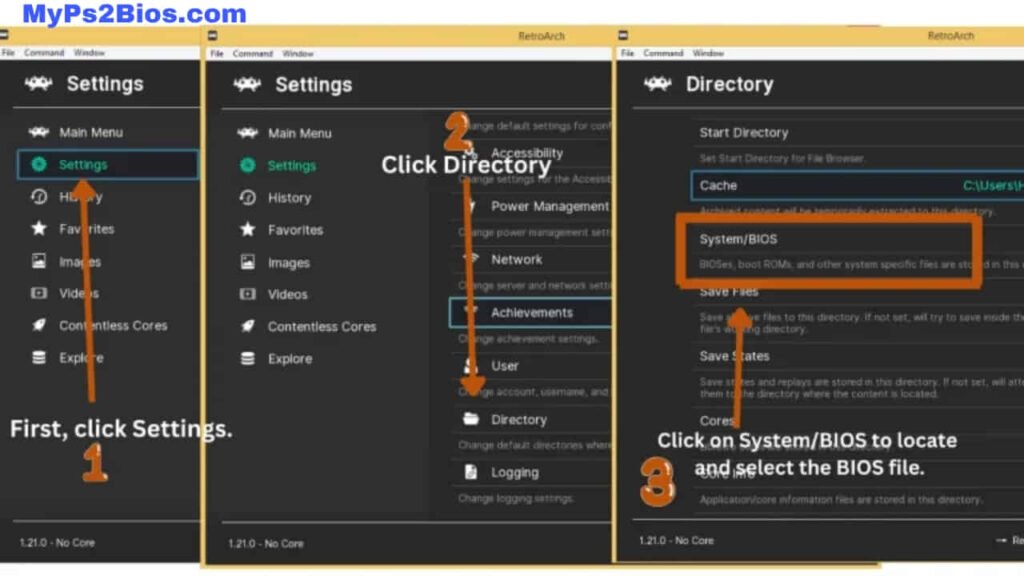
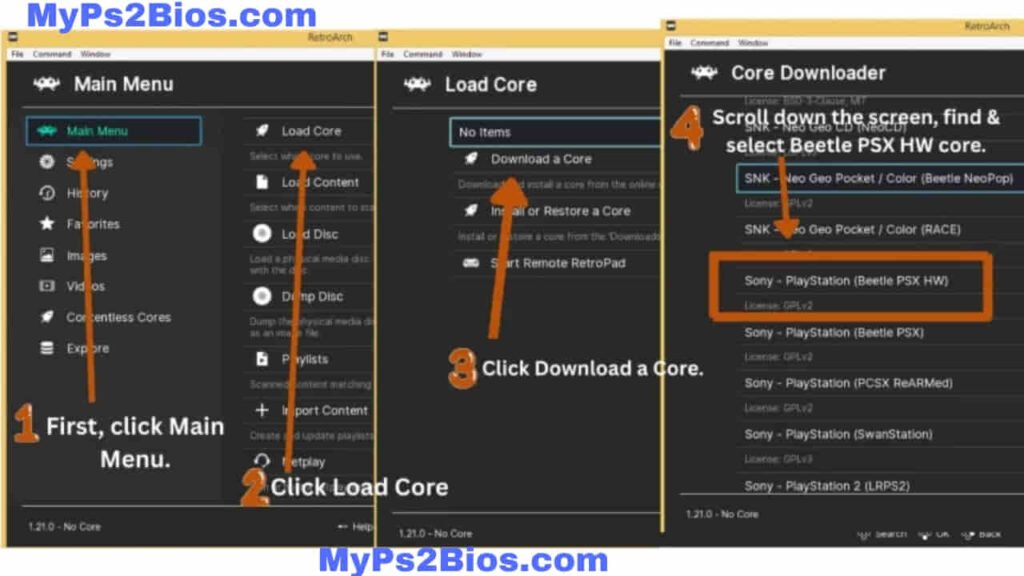
Next, install the Beetle PSX core:
- Open the Main Menu.
- Select Load Core.
- Choose Download a Core.
- Download Beetle PSX (HW).
Unlike standalone emulators, RetroArch requires emulator cores to run PlayStation games, and Beetle PSX is one of the most accurate options available.
For DuckStation
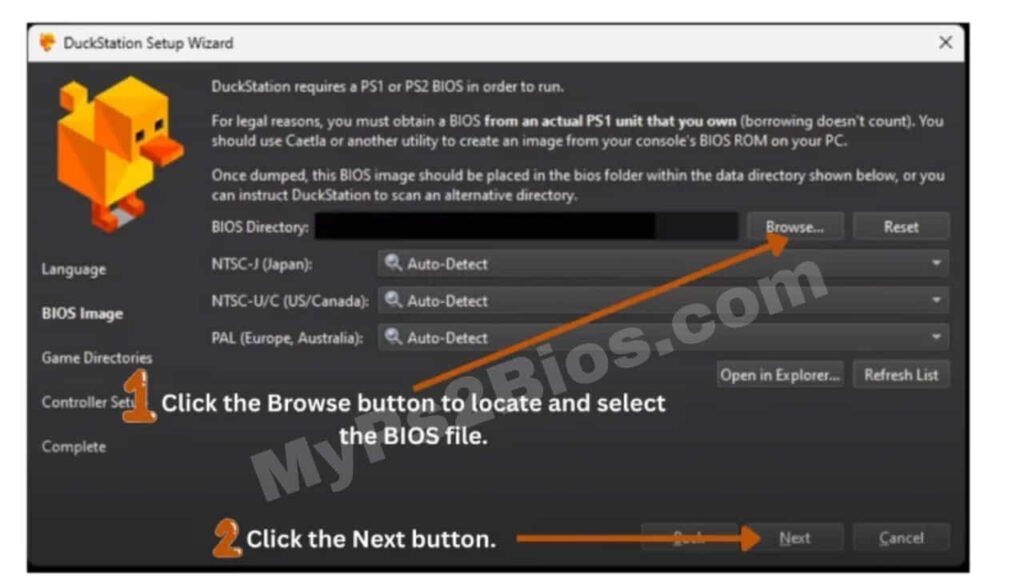
You can import the BIOS file while launching it. Open the DuckStation.Set up the language and theme of your choice, and click the next button. In the next follow the steps as given in the image below.
- Launch DuckStation.
- Complete the initial language and appearance setup.
- Click Next until you reach the BIOS configuration page.
- Select Browse.
- Locate your BIOS file and import it.
- Continue through the remaining setup wizard.
- Click Finish to complete the installation.
How to Set Up PS1 BIOS on Mobile (Android & iOS)
Installing a PlayStation BIOS on Android or iPhone is straightforward once your files are ready. The overall process is similar to the desktop version, with only minor differences in file locations.
Download the Required Files
You’ll need:
- A legally obtained PS1 BIOS file
- Your preferred emulator (DuckStation, ePSXe, or RetroArch)
- ZArchiver (Android) or another file extraction app if your files are compressed
- A PlayStation game image (.bin, .cue, .iso, etc.)
Extract the Files / Unzip the Files:
Use ZArchiver or another archive manager to extract the BIOS and game files into their original formats. Store them in an easy-to-find folder on your device.
Configure the PS1 BIOS
The setup process varies slightly depending on the emulator.
For ePSXe Emulator (Android)
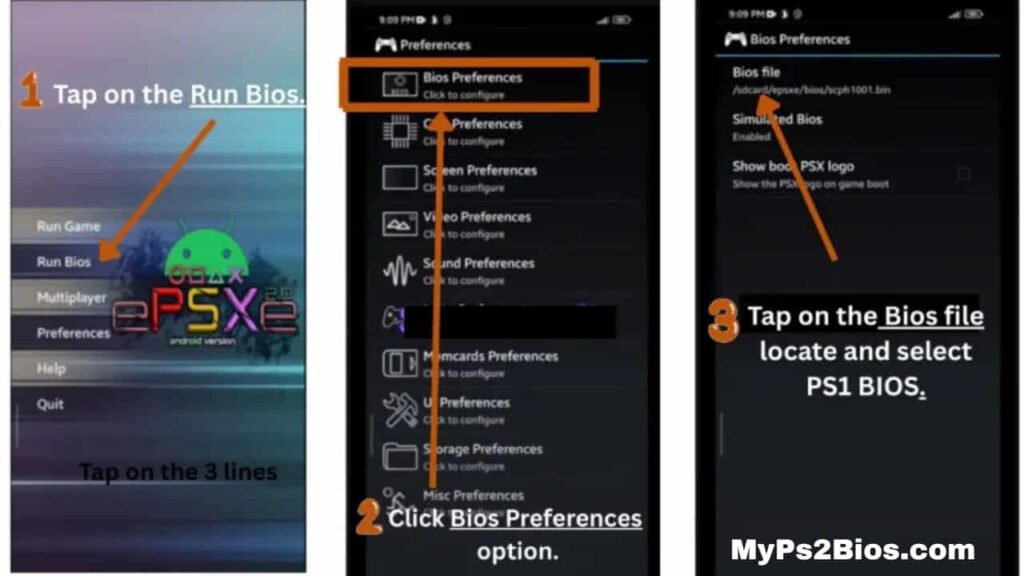
- Install ePSXe from the Google Play Store.
- Open the emulator.
- Tap Run BIOS.
- Open BIOS Preferences.
- Select BIOS File.
- Browse your device storage and choose the BIOS file.
For RetroArch (Android & iOS)
- Install RetroArch from Google Play or the App Store.
- Copy the BIOS into the RetroArch system folder.
Android Example
/storage/emulated/0/RetroArch/system/
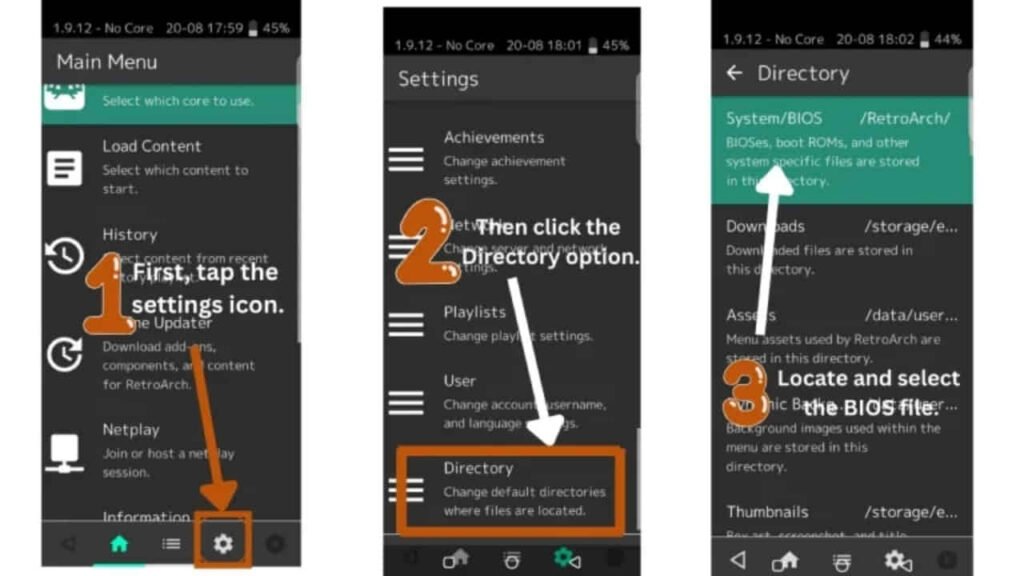
- Open RetroArch.
- Go to Settings → Directory → System/BIOS.
- Confirm that the directory points to the folder containing your BIOS.
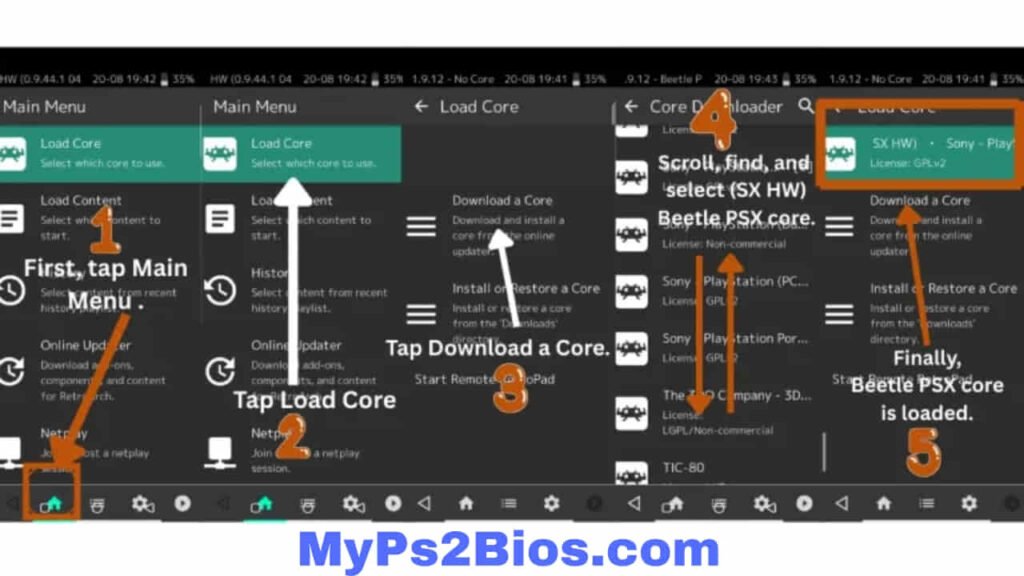
Next, install the PlayStation core:
- Return to the Main Menu.
- Tap Load Core.
- Select Download a Core.
- Install Sony – PlayStation (Beetle PSX HW).
After installation, RetroArch will be ready to load compatible PlayStation games.
For DuckStation (Android)
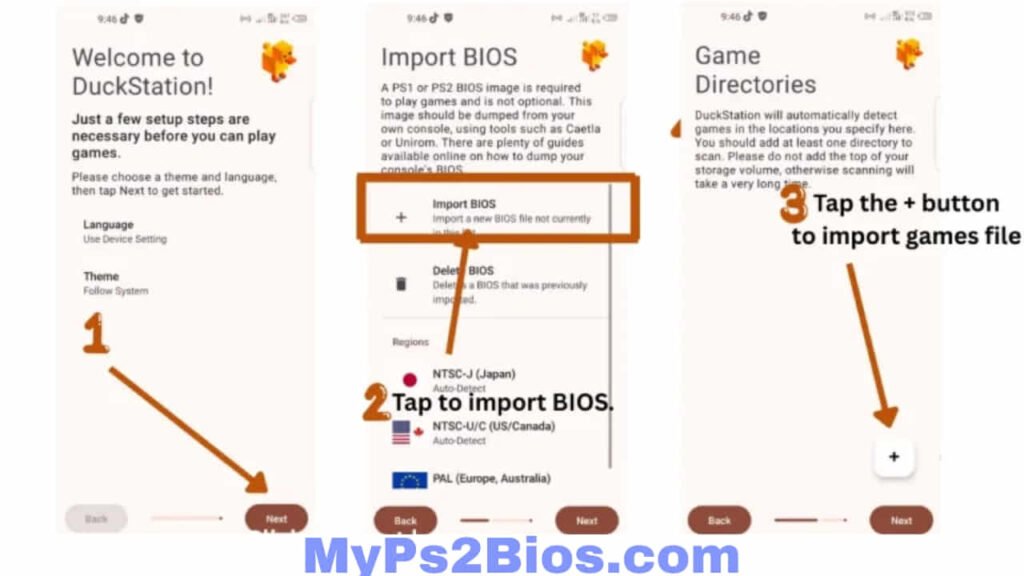
Install it from the Play Store. Open the DuckStation emulator on your Android phone, and follow the steps as shown in the image below.
- Install DuckStation from the Google Play Store.
- Launch the application.
- Complete the initial setup wizard.
- On the BIOS screen, tap Import BIOS or the + icon.
- Browse to your BIOS location.
- Select the BIOS file.
- Tap Next and complete the remaining setup.
Once the BIOS has been detected successfully, DuckStation is ready to launch supported PlayStation games with improved compatibility and accuracy.
Where to Obtain a PS1 BIOS Legally? (Copyright & Usage Guide)
The PS1 BIOS is proprietary firmware developed by Sony for the original PlayStation console. Because it is protected by copyright, it cannot be freely distributed or downloaded from unauthorized websites. The recommended and legally safest method is to dump the BIOS from a PlayStation console that you personally own using compatible homebrew tools and hardware.
Using your own BIOS provides the most authentic emulation experience while respecting copyright laws. It also ensures better compatibility with popular PlayStation emulators such as DuckStation, ePSXe, and RetroArch. Before downloading or using any BIOS file, it’s always a good idea to check the copyright regulations that apply in your country or region.
Why Use Our Guide?
Our goal is to provide accurate, beginner-friendly information that helps you understand PlayStation emulation without unnecessary confusion. Instead of focusing on unofficial downloads, we explain how the BIOS works, how to configure it correctly, and how to troubleshoot common issues across different emulators. Whether you’re new to retro gaming or an experienced emulator user, this guide is designed to help you set up your PlayStation emulator safely and correctly.
Where to Place BIOS Files in Emulators?
After obtaining your BIOS, it must be placed in the correct directory so your emulator can detect it automatically. Although every emulator uses a slightly different folder structure, most include a dedicated BIOS or System directory for firmware files.
Below are the default locations used by the most popular PlayStation emulators:
| Emulator | Default BIOS Location |
| DuckStation | BIOS folder selected during setup or Settings → BIOS |
| ePSXe | BIOS folder inside the ePSXe installation directory |
| RetroArch | system folder (configured through Settings → Directory → System/BIOS) |
Once the BIOS is copied into the correct folder, restart the emulator. Most modern emulators will automatically detect the firmware, while others may require you to manually select the BIOS location in the emulator settings.
Supported Emulators for PS1 BIOS
Several PlayStation emulators support the original PS1 BIOS to improve compatibility, accuracy, and overall gaming performance. Each emulator offers different features, but all can benefit from a properly configured BIOS.
ePSXe (PC & Android)
ePSXe is one of the oldest and most trusted PlayStation emulators available for Windows and Android. It offers excellent compatibility, customizable graphics and controller settings, memory card support, save states, and plugin-based enhancements. When used with a properly configured PS1 BIOS, ePSXe delivers a reliable and authentic PlayStation gaming experience.
Key Features:
- High compatibility with PS1 games
- Save states and memory card support
- Controller customization
- Graphics enhancement options
- Available for Windows and Android
RetroArch (PC, iOS & Android)
RetroArch is a powerful multi-system frontend that supports dozens of classic gaming consoles through downloadable emulator cores. For PlayStation emulation, the Beetle PSX and SwanStation cores provide accurate performance when paired with a compatible PS1 BIOS. RetroArch also supports advanced features such as shaders, achievements, rewind, and cloud synchronization.
Key Features:
- Multi-console emulator platform
- Beetle PSX and SwanStation cores
- Cross-platform support
- Shader and filter support
- RetroAchievements integration
DuckStation (PC & Android)
DuckStation is one of the most popular modern PlayStation emulators because of its excellent accuracy, user-friendly interface, and performance improvements. It supports hardware rendering, widescreen enhancements, texture filtering, fast boot, and numerous quality-of-life features while maintaining excellent compatibility with the PlayStation library.
Key Features:
- Highly accurate PlayStation emulation
- Fast and lightweight performance
- Hardware-accelerated graphics
- Widescreen and upscaling support
- Available for Windows, Linux, macOS, and Android
Common PS1 BIOS Errors and Fixes
Even after configuring your PS1 BIOS, you may occasionally run into issues while using emulators like DuckStation, ePSXe, or RetroArch. Most problems are caused by incorrect BIOS placement, mismatched BIOS regions, damaged game files, or improper emulator settings. Fortunately, these errors are easy to fix once you identify the root cause.
No BIOS Loaded
Issue:
If your emulator displays a “No BIOS Loaded” message, it cannot detect the BIOS file. This usually happens when the BIOS is missing, renamed, corrupted, or stored in the wrong folder. In DuckStation, this error commonly occurs when the BIOS isn’t placed inside the System/BIOS directory.
Fix:
Move the BIOS file (such as SCPH1001.BIN) into the correct BIOS folder, keep its original filename unchanged, and verify that the emulator is pointing to the correct BIOS directory. Restart the emulator after making the changes.
Game Crashes After BIOS Screen
Issue:
If the game crashes immediately after the PlayStation startup logo, the BIOS may be incompatible with the game region, corrupted, or the game image itself may be damaged.
Fix:
Use a clean BIOS that matches your game’s region, verify the integrity of the game image, and update your emulator to the latest stable version if the issue persists.
Lagging or Slow Game Performance
Issue:
Slow gameplay, low frame rates, or long loading times are usually caused by demanding graphics settings, outdated drivers, or limited system resources instead of the BIOS itself.
Fix:
Reduce the internal resolution, enable hardware acceleration, and try a different graphics renderer such as Vulkan, OpenGL, Direct3D 11, or Direct3D 12. Closing unnecessary background applications can also improve performance.
Incorrect Region Error
Issue:
A PlayStation game may fail to boot if its region doesn’t match the installed BIOS. For example, running a PAL game with an NTSC BIOS can lead to compatibility problems.
Fix:
Always use the BIOS that corresponds to your game’s region:
- SCPH1001.BIN — USA (NTSC-U)
- SCPH5502.BIN — Europe (PAL)
- SCPH5500.BIN — Japan (NTSC-J)
Using the correct regional BIOS improves compatibility and reduces startup errors.
Corrupted Save Files
Issue:
Save files can become corrupted if the virtual memory card is damaged, the emulator closes unexpectedly, or the save process is interrupted.
Fix:
Create a new virtual memory card, regularly back up your save files, and always exit the emulator properly after saving your progress.
Game Freezes or Stutters During Cutscenes
Issue:
Freezing or stuttering during videos and cutscenes is commonly caused by incompatible graphics settings, outdated emulator versions, or damaged game files.
Fix:
Update your emulator, switch to another graphics backend if necessary, and verify that your game image is complete and free from corruption. Testing another compatible BIOS version may also resolve the issue.
Disc Image Not Detected
Issue:
If the emulator cannot detect your game disc image, the file may be corrupted, incorrectly extracted, or saved in an unsupported format.
Fix:
Use supported formats such as BIN/CUE, ISO, or IMG. If you’re using BIN/CUE files, make sure both files remain together in the same folder and that the CUE file correctly references the BIN file.
Graphics Glitches or Screen Tearing
Issue:
Screen tearing, flickering textures, missing graphics, or visual artifacts are usually caused by graphics settings or outdated GPU drivers.
Fix:
Update your graphics drivers, enable V-Sync, and test different rendering backends such as Vulkan, OpenGL, or Direct3D. Resetting the emulator’s graphics settings to their default values may also help.
High CPU Usage or Overheating
Issue:
Using high rendering resolutions, texture filtering, shaders, or other advanced enhancements can place heavy demands on your CPU and GPU, causing overheating or reduced performance.
Fix:
Lower the rendering resolution, disable unnecessary graphics enhancements, reduce texture filtering, and close resource-intensive applications running in the background.
Audio Desync or Lag
Issue:
Delayed or out-of-sync sound is usually caused by incorrect audio latency settings, unstable frame rates, or mismatched regional refresh rates.
Fix:
Enable audio synchronization in your emulator, adjust the audio latency settings, and make sure the game is running at the correct refresh rate (NTSC 60 Hz or PAL 50 Hz) for smooth audio and video synchronization.
Conclusion
The PS1 BIOS is the foundation of accurate PlayStation emulation, allowing emulators like DuckStation, ePSXe, and RetroArch to recreate the original console with better compatibility, smoother gameplay, and reliable memory card support.
Whether you’re using PS1 BIOS SCPH1001 for North American games or PS1 BIOS SCPH5501 and other regional firmware for different PlayStation releases, selecting the correct PS1 BIOS file is essential for the best experience.
If you’re wondering which PS1 BIOS to use or looking for the best PS1 BIOS for DuckStation, the answer depends on your game’s region and emulator settings rather than a single universal BIOS.
Once the BIOS is configured correctly, most startup errors, crashes, and compatibility issues disappear, allowing you to enjoy classic PlayStation games on Windows, Android, and other supported platforms with confidence.
For the most reliable and legally compliant experience, use a BIOS dumped from a PlayStation console you own and keep your emulator updated to benefit from the latest performance improvements and compatibility fixes.